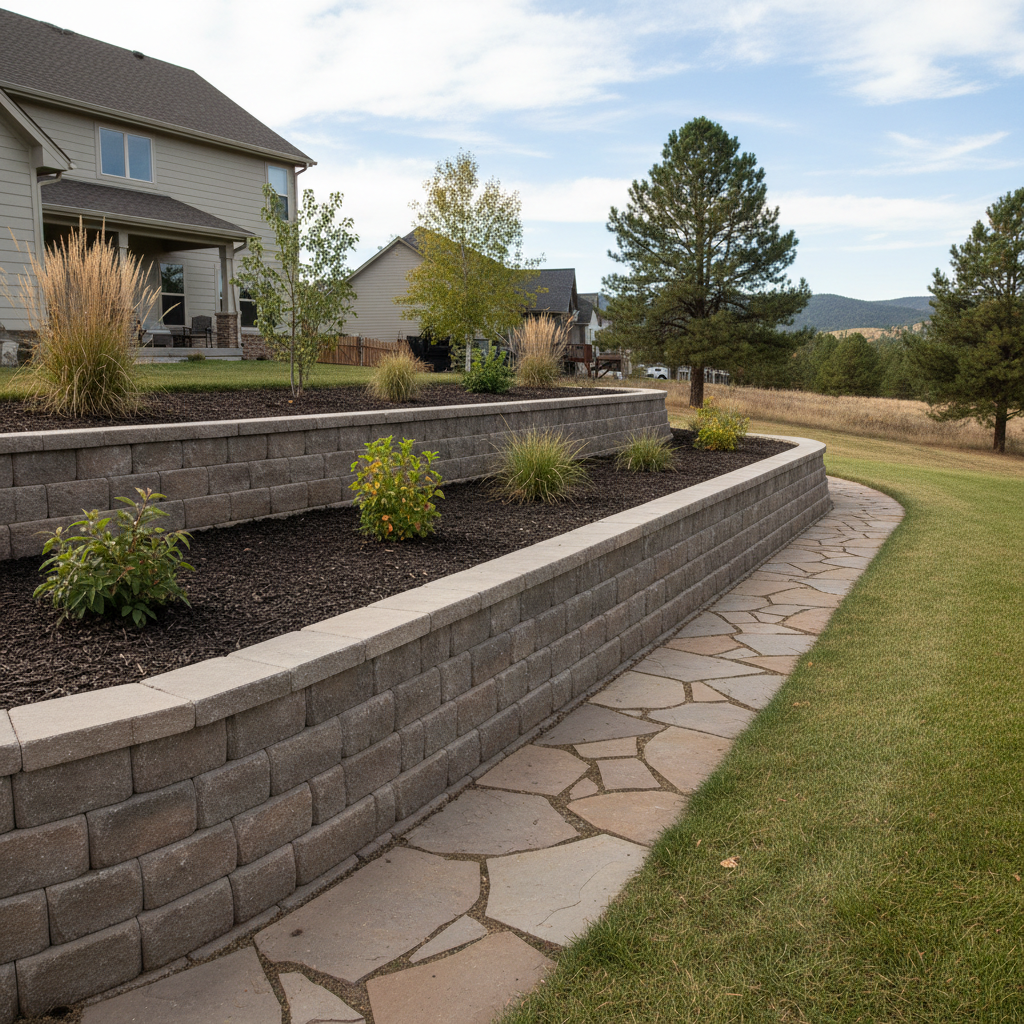
Freshly built hillside yards sliding right back down into a neighbor's driveway after a heavy spring downpour happen more often than people think around Rapid City, SD. Building on the slopes around Rapid City is very different compared to flatland construction. When dealing with the clay-heavy soils and steep elevation changes typical of neighborhoods up near the Black Hills foothills, small shortcuts during a Retaining Wall project turn into very expensive disasters down the road.
Skipping proper drainage is the most destructive mistake homeowners make during Retaining Wall construction. People focus entirely on the stackable blocks or the stone face, forgetting about the immense hydrostatic pressure that builds up behind the Retaining Wall. When spring snowmelt kicks in and water has nowhere to go, it pushes against that masonry until something gives. Guardian Landscaping treats clean gravel backfill and functional weep holes or drain tile as non-negotiable baselines, not optional add-ons. If a contractor tries to tell you that regular old native dirt backfill is fine behind the Retaining Wall, show them the door.
Another trap is letting the lowest bidder breeze past the foundation trench. A Retaining Wall is only as stable as the compacted base it sits on. If they are not digging down past the frost line or soft topsoil to lay down a thick, heavily compacted crushed rock leveling pad, your Retaining Wall is going to start settling unevenly within a couple of seasons. You will notice the caps starting to wave, joints opening up, and sections leaning forward. Fixing a collapsed Retaining Wall costs three times more than doing it right the first time.
Permits and engineering requirements catch people off guard too. In Pennington County and within Rapid City limits, any Retaining Wall over a certain height requires professional engineering stamps and permits. Ignoring this does not just risk municipal fines; it means nobody calculated the surcharge loads from nearby driveways or parking areas above the Retaining Wall. If you have got a slope that is actively eroding or threatening your property lines, take your time, vet your contractors thoroughly, and make sure whoever you hire understands local Black Hills earth conditions inside and out.